Free Shipping over $75 | Ships Out Same-Day | SAVE 30% STOREWIDE, CODE "HALLOWEEN30"
What Are the Effects of the Myrcene Terpene? Benefits and Common Sources
The myrcene terpene effects most people talk about come down to one thing: that heavy, settled-in, “couch-lock” feeling. If you have ever read a terpene label and seen “myrcene” sitting at the top, you have met the most talked-about terpene in cannabis, the earthy, musky one credited for that relaxed body sensation.
But terpene marketing moves fast, and the real myrcene terpene effects are narrower than the hype suggests. So let’s separate what we actually know from what got passed around the internet until it sounded like fact.
At Pure Standard Extracts, we wrote this as a plain-English breakdown of what myrcene is, where it shows up, and what the research really says. Contact us today to ask how myrcene shows up across our formats.
So What Exactly Is Myrcene? (The Short Version)
Myrcene, sometimes written as beta-myrcene, is a monoterpene found across more than 200 plant species. In cannabis, it is often described as the most common terpene of all, which is a big reason it gets so much attention.
The aroma is the easiest way to recognize it. People describe it as earthy, musky, and herbal, with a slightly clove-like or peppery edge and the occasional fruity, mango-like note depending on the plant.
Here is a quick look at where myrcene turns up most and the vibe people tend to associate with each source. Treat the “commonly reported effect” column as folklore and user reports, not proven outcomes.
Common Source
Aroma Note
Commonly Reported Association
Mango
Sweet, tropical, fruity
The “mango trick” folklore
Hops
Green, herbal, “hoppy”
Relaxed, mellow feeling
Lemongrass & thyme
Citrusy, earthy, savory
Calming, kitchen-herb warmth
Cannabis
Musky, earthy, dank
The “couch-lock” reputation
Where You Actually Run Into Myrcene
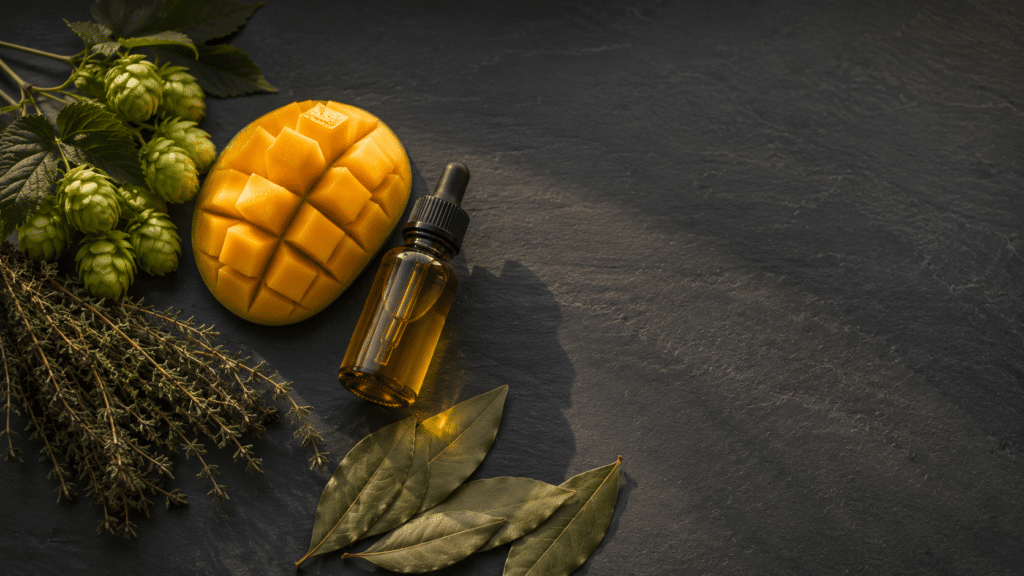
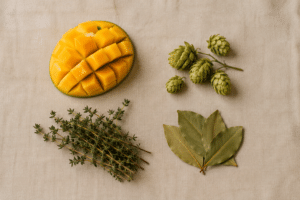
Myrcene appears in mangoes, hops, lemongrass, thyme, bay leaves, basil, verbena, and cannabis, among more than 200 plant species. It shows up in food, drinks, and the herb shelf long before you ever get to a cannabis label, so it is far more familiar than most people realize.
Mangoes
Mango is the source most people have heard linked to myrcene. Ripe mangoes are often cited as one of the richest fruit sources of myrcene, and that level tends to climb as the fruit gets riper, though the actual amount in fruit is small compared with cannabis.
That sweet, tropical smell is part of why mango became the poster child for myrcene talk. The riper the fruit, the more of that aromatic compound it tends to hold, which is exactly why the “eat a mango first” idea took off.
We will get to the mango myth in a minute, because it deserves an honest look. For now, just know that mango is a real myrcene source, even if its reputation got ahead of the evidence.
Hops (Yes, Your Beer)
Hops are one of the richest natural sources of myrcene, which is the most plentiful oil in the hop plant. Brewing experts note it has one of the lowest odor thresholds of the hop oils, which is part of that fresh, “hoppy” punch in a pale ale or IPA.
Interestingly, a lot of myrcene boils off during a long wort boil, so much of it never makes it into the finished beer. The aroma you get from a heavily dry-hopped beer is the closest you tend to come to raw hop myrcene.
Lemongrass, Thyme, and the Herb Shelf
Myrcene is hiding in your spice rack, too. Lemongrass, thyme, bay leaves, basil, and verbena all carry it, which is part of why those herbs share that earthy, slightly green aroma.
This is a useful reminder that terpenes are not exotic cannabis-only chemicals. They are the same aromatic compounds that make a Sunday roast or a cup of lemongrass tea smell the way they do.
It also explains why myrcene feels so familiar the first time you smell a myrcene-heavy strain. Your nose has met it many times before, just in the kitchen instead of the dispensary.
Cannabis Itself
In cannabis, myrcene is frequently one of the dominant terpenes in the overall profile. When a flower smells deeply musky, earthy, and almost dank, myrcene is usually a big part of that signature.
Because it is so common, it became shorthand for a certain “heavy” style of cannabis. Whether that shorthand actually holds up is a different question, and one worth poking at.
Lab testing is the only way to know how much myrcene a given product really contains. Two flowers can smell similar yet show very different terpene numbers once you read the actual report.
Myrcene Terpene Effects: What It Actually Does
The most commonly reported myrcene terpene effects are relaxation and a sedative, heavy-bodied “couch-lock” feeling, but those reports come mainly from user anecdote rather than settled human research. Myrcene has a big reputation, and separating that reputation from proven effects is exactly where things get fuzzy, so let’s stay honest.
The “Couch-Lock” Reputation
The headline claim is sedation. Some users report that myrcene-rich strains feel heavier in the body, the classic “couch-lock” experience, where you sink into the sofa.
It is worth being clear that this is largely user lore and anecdote, not settled science. Plenty of factors shape how a session feels, and pinning it on one terpene oversimplifies a complicated picture.
That does not mean the reports are worthless, since enough people describe the same feeling to take it seriously. It just means we should hold the claim loosely until better human research catches up.
What Early Research Has Looked At
On the lab side, preclinical research has explored myrcene for sedative, pain-related, anti-inflammatory, and antioxidant activity. Those studies are mostly in cells and animals, often at doses far higher than you would get from cannabis or a mango.
So the honest framing is “studied for,” not “proven to.” We do not make medical claims about myrcene, and you should be skeptical of anyone who does.
The Entourage-Effect Angle
You will often hear myrcene tied to the “entourage effect,” the idea that terpenes and cannabinoids work together to shape your experience. It is a popular theory, and it is a reasonable hypothesis.
The catch is that the human evidence is thin. Most support comes from preclinical work using concentrations well above what is in real cannabis, supplements, or fruit, so treat the entourage effect as an interesting idea rather than a proven mechanism.
Why Aroma and Vibe Aren’t the Same Thing
It is tempting to assume a strong myrcene smell guarantees a strong sedating effect. Aroma and effect are related, but they are not interchangeable.
Your tolerance, the cannabinoid content, your mindset, and even the setting all move the needle. Myrcene may contribute to the character of an experience, but it is one instrument in a much larger band.
The Mango Myth (Let’s Be Honest About It)
No controlled human trial has shown that eating a mango before cannabis meaningfully boosts your high, so the popular “mango trick” remains folklore rather than fact. The claim you have probably seen is that eating a ripe mango about 45 minutes before cannabis lets the myrcene “supercharge” your high, and it spreads because it sounds science-adjacent.
The problem is that it has never been replicated in a controlled human trial. Mango does contain myrcene, but the amount that actually reaches your bloodstream and brain from eating fruit is far below the levels used in animal sedation studies.
That gap between a tiny dietary dose and a lab dose is the whole issue. You would likely have to eat an unrealistic amount of fruit to approach the concentrations researchers used, and even then the effect is unproven in people.
A related myth is the “0.5% myrcene means a strain is an indica couch-lock” rule. That specific threshold has no peer-reviewed source and appears to trace back to a single uncited blog post, so we would not build any expectations around it.
What This Means If You’re Shopping for Terpene-Rich Products
If you care about terpenes like myrcene, the practical takeaway is simple: chase verified quality, not internet folklore. A terpene only matters if it is actually in the product and accurately labeled.
That is why we lean on testing rather than hype. You can check the actual terpene and cannabinoid content in our third-party lab reports instead of taking a label’s word for it.
From there, it comes down to picking a format you enjoy. Whether you prefer vapes or another form, you can explore our cannabinoid lineup and match the terpene profile to the experience you are after.
A good habit is to read the terpene panel the same way you read a nutrition label. Look at what is actually present, in what amounts, and let that guide your choice rather than a strain name or a viral tip.
Where to Start With Terpene-Rich Products
Myrcene is a great example of why honesty beats hype in this space, since the real story is more nuanced than the mango trick suggests. The smartest move is choosing lab-tested products and judging them by how they actually feel for you, not by a viral claim.
If you want help reading a terpene profile or picking a format, our team at Pure Standard Extracts is glad to talk it through before you buy. Call us today to read a terpene profile with our help.
Disclaimer: These statements have not been evaluated by the Food and Drug Administration. This product is not intended to diagnose, treat, cure, or prevent any disease. For adults 21 and older. Individual results vary. Consult your healthcare provider before use, especially if you are pregnant, nursing, or taking medication.
Frequently Asked Questions
What is the myrcene terpene?
Myrcene, also written as beta-myrcene, is a monoterpene found in more than 200 plants, including cannabis, hops, mangoes, and lemongrass. In cannabis it is often described as the most common terpene, known for an earthy, musky aroma. People associate it with relaxation, though that reputation rests more on user reports than proven science.
What does myrcene smell like?
Myrcene has an earthy, musky, and herbal aroma with a slightly clove-like or peppery edge. Depending on the plant, it can also carry a faint fruity or mango-like note. It is a big part of the deep, dank smell many people recognize in cannabis flower and in fresh hops.
What are the effects of myrcene?
Myrcene is most associated with relaxation and the heavy “couch-lock” feeling some users report from myrcene-rich strains. Preclinical research has studied it for sedative and anti-inflammatory properties, but human evidence is limited. The effects you actually feel depend far more on cannabinoids, dose, and your own tolerance than on any single terpene.
Is myrcene an indica or sativa terpene?
Myrcene shows up in both indica and sativa-labeled cannabis, so it is not exclusive to either category. The popular idea that a strain with over 0.5% myrcene is automatically a sleepy indica has no peer-reviewed backing. Indica and sativa labels describe plant structure more than guaranteed effects, so treat that rule as folklore.
Does eating mango before cannabis make you higher?
There is no controlled human study showing that eating a mango before cannabis boosts your high. Mango does contain myrcene, but the amount reaching your bloodstream from fruit is far below the doses used in animal research. It is a fun experiment to try; just do not expect it to reliably change anything.
What foods and plants contain myrcene?
Beyond cannabis, myrcene is found in mangoes, hops, lemongrass, thyme, bay leaves, basil, and verbena, among more than 200 plant species. Hops are one of the richest sources, which is why it is prominent in hoppy beers. Ripe mangoes are commonly cited as containing some of the highest fruit concentrations.
Is myrcene safe?
Myrcene occurs naturally in many common foods and herbs that people eat every day, such as mango, thyme, and lemongrass. In those everyday food amounts it is widely regarded as well tolerated. As with any concentrated extract, what matters most is buying lab-tested products and following the label for adults 21 and older.
What is the entourage effect?
The entourage effect is the theory that cannabis terpenes like myrcene and cannabinoids work together to shape the overall experience. It is a popular idea, but the human evidence is thin and mostly drawn from preclinical studies at high doses. It is best treated as an interesting hypothesis rather than an established fact.
Key Takeaways Cordyceps is a functional mushroom with a long-standing reputation for supporting energy and stamina. Many people use it before activity, although the research is still developing and it should not be treated as a sure thing. It may help some people, and that is as far as anyone
Key Takeaways Reishi is a functional mushroom with a long history in traditional wellness, where it is most often associated with calm and rest. Research is still developing, so it is best understood as a traditional ingredient and not as a treatment for anything. Reishi is most commonly associated with
Key Takeaways There is no single amount of Amanita muscaria that is safe for everyone, because products, extracts and people all differ. The careful approach is to follow the label on a lab-tested product, begin with the smallest serving and give it plenty of time. We will not give you

 Mango is the source most people have heard linked to myrcene. Ripe mangoes are often cited as one of the richest fruit sources of myrcene, and that level tends to climb as the fruit gets riper, though the actual amount in fruit is small compared with cannabis.
 If you care about terpenes like myrcene, the practical takeaway is simple: chase verified quality, not internet folklore. A terpene only matters if it is actually in the product and accurately labeled.