Free Shipping over $75 | Ships Out Same-Day | SAVE 30% STOREWIDE, CODE "HALLOWEEN30"
What Is the Strongest Delta-8 Vape Juice, and How Is Potency Measured?
There is no official standard for the “strongest” Delta-8 vape juice, so the word is mostly marketing. Real strength is measured two ways on a lab report: milligrams of cannabinoid per unit and percentage by weight of the extract. The only reliable way to compare products is to read a current third-party Certificate of Analysis, match it to the batch, and ignore the label hype.
Search “strongest Delta-8 vape juice” and you get a wall of bold potency claims, but almost none of them explain how that strength is actually measured. Strength on a label is only meaningful if a lab report backs it up.
At Pure Standard Extracts, we think you should be able to read a potency number and know exactly what it means before you buy. That starts with understanding milligrams, percentages, total cannabinoids, and the Certificate of Analysis that ties them together.
If you want help making sense of a lab report or choosing a vape that matches your tolerance, Contact us today to talk it through with our team. Keep reading for the full breakdown on how potency is measured, why “strongest” is usually a marketing word, and how Delta-8 stacks up against more potent cannabinoids.
What does “strongest Delta-8 vape juice” actually mean?
The phrase sounds precise, but it has no agreed definition. There is no federal or industry standard that ranks one Delta-8 vape as objectively “strongest,” so the claim is almost always a marketing line rather than a measured fact.
It also helps to be clear about the product category. “Vape juice” usually refers to a bottled e-liquid you pour into a refillable tank, and that is a different format from the sealed carts and disposables most hemp brands sell. We do not sell bottled Delta-8 e-liquid; our vape lineup is built around pre-filled cartridges and disposables, so this guide explains the concept generally and shows you how to judge strength in any vape format.
When a product calls itself the strongest, the honest question is always the same: strongest by what measurement, and where is the lab report that proves it? You can explore our vape and disposable lineup to see how potency is disclosed on lab-tested products rather than asserted on a label.
How is cannabinoid potency measured and labeled?
Potency is not a vibe or a marketing tier; it is a set of numbers a laboratory measures. Understanding the four figures below lets you compare any two vapes on the same footing.
Milligrams of cannabinoid per unit
The most common potency figure is milligrams (mg) of a specific cannabinoid in the unit. A disposable or cartridge might list, for example, the total mg of Delta-8 in the device. This number tells you how much active cannabinoid is present overall, which is useful for comparing devices of a similar size.
The catch is that mg alone ignores volume. A larger device can carry more total milligrams while being less concentrated per puff, so milligrams are most useful when you compare products of the same fill size.
Percentage by weight
Percentage by weight describes how concentrated the extract or distillate is, expressed as a share of the total formula. A distillate listed at a high percentage of a given cannabinoid is more concentrated than one at a lower percentage, regardless of the device size.
This is why percentage and milligrams answer different questions. Percentage tells you how concentrated the oil is, while milligrams tell you how much cannabinoid the whole unit holds. Reading both together gives you the clearest picture of real strength.
Total cannabinoids versus a single cannabinoid
A lab report also lists “total cannabinoids,” which is the combined sum of every cannabinoid the lab detected, not the amount of Delta-8 by itself. Because that total is a calculated figure that can include conversion factors for acidic forms, it will often read higher than the single Delta-8 line.
Confusing the two is a common way labels overstate strength. A product can advertise a big total-cannabinoid number while the actual Delta-8 content is much lower, so always check the individual cannabinoid line, not just the total.
Reading the Certificate of Analysis
All of these numbers live on a Certificate of Analysis (COA), the third-party lab report that verifies what is in a product. Below is how the main potency metrics map to what they mean and where you see them in practice.
Potency Metric
What It Means
Example
Milligrams (mg) per unit
Total amount of a specific cannabinoid in the whole device or container.
“900 mg Delta-8” in a single cartridge.
Percentage (%) by weight
How concentrated the cannabinoid is within the extract or distillate.
Distillate testing at a high Delta-8 percentage by weight.
Total cannabinoids
Calculated sum of all detected cannabinoids, not Delta-8 alone.
A total figure that runs higher than the single Delta-8 line.
COA verification
Third-party lab report confirming the numbers match the batch.
A current report with a batch or lot number you can match.
A reputable COA is produced by an independent laboratory, typically using High-Performance Liquid Chromatography (HPLC), the standard method for measuring cannabinoid content because it tests at room temperature and reports each compound separately. You can review the lab reports behind our products on our lab reports page to see how this looks in practice.
How does Delta-8 compare to more potent cannabinoids?
Part of judging “strongest” is knowing where Delta-8 sits among hemp cannabinoids. Research gives us a general ranking, though it mixes human data with laboratory receptor studies, so treat the order as approximate rather than a fixed scale.
Delta-8 versus Delta-9
Delta-8 THC is generally described as the milder relative of Delta-9 THC. The research that exists puts Delta-8 at roughly half to two-thirds the potency of Delta-9, though the figures vary by study and by how the cannabinoid is consumed.
For a vape shopper, the practical takeaway is that Delta-8 is usually a more moderate experience than Delta-9 at a comparable dose. That is why many people use Delta-8 as an accessible entry point into intoxicating hemp cannabinoids.
THC-P and the seven-carbon side chain
THC-P is a far more potent cannabinoid built around a seven-carbon side chain instead of the standard five-carbon chain. A 2019 study in Scientific Reports (Citti et al.) found THC-P bound the CB1 receptor with more than thirty times the affinity of Delta-9 THC in laboratory testing.
That figure is striking, but binding affinity in a lab is not the same as being thirty times stronger per milligram in real use. Absorption, metabolism, and dose all shape the actual experience, which is why THC-P is treated as high-potency and approached with a conservative starting amount.
HHC-P and the phorol class
HHC-P shares that same seven-carbon phorol structure, paired with a hydrogenated core for added stability. A 2025 study in Drug Testing and Analysis (Persson et al.) measured HHC-P activating the CB1 receptor at roughly twice the potency of standard HHC in laboratory testing.
Like THC-P, HHC-P belongs to the high-potency phorol class and sits well above Delta-8 on receptor metrics. If Delta-8 is your benchmark, both phorol cannabinoids warrant a much smaller starting dose. You can compare these cannabinoids across our full cannabinoid lineup and their lab reports.
The approximate potency order
Putting it together, hemp cannabinoids are generally understood to rank from milder to stronger as Delta-8, then Delta-9 and HHC in a similar range, then the phorol-class THC-P and HHC-P well above them. HHC is commonly reported as slightly milder than Delta-9, though controlled human data on that comparison are limited.
The honest framing is that this is a directional guide, not a precise ladder. Individual response, tolerance, and product format all influence how strong any cannabinoid feels in practice.
How can you verify a vape’s real strength before buying?
Once you know what the numbers mean, verifying a product is straightforward. The goal is to confirm the strength a label claims is the strength a lab actually measured.
Match the COA to the batch
A lab report is only meaningful if it matches the product in your hand. Look for a batch or lot number on the COA that corresponds to the product, and check that the report is current rather than years old. A reputable seller makes these reports easy to find rather than burying them.
Check the single-cannabinoid line, not just the total
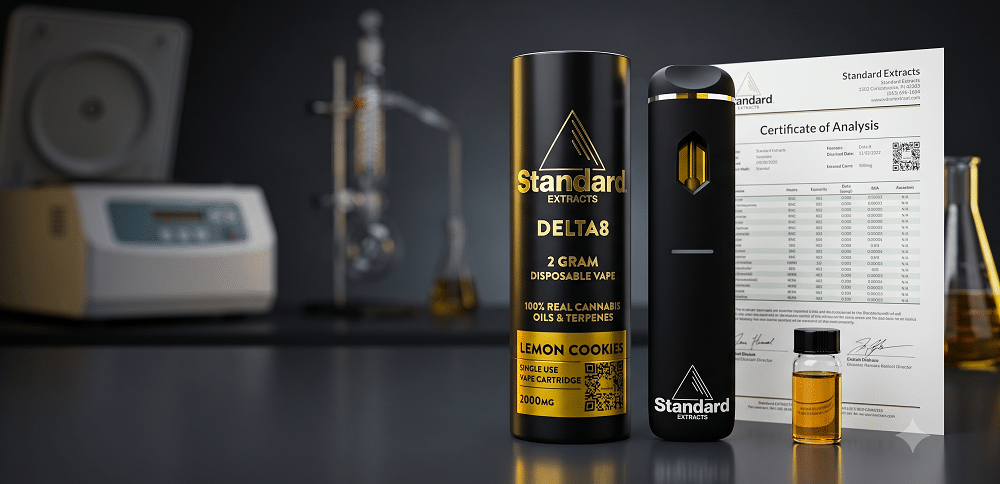
Because total cannabinoids sum every detected compound, that figure can overstate how much Delta-8 a product really contains. Find the individual Delta-8 line on the COA and compare it to what the label advertises. If the label leans on a big total number while the Delta-8 line is modest, the marketing is doing the heavy lifting.
Confirm the testing method
The most reliable potency numbers come from independent labs using HPLC, which separates and measures each cannabinoid accurately. A COA from a recognized third-party lab carries far more weight than an in-house claim with no supporting report.
Treat “strongest” as a prompt, not a promise
Because no standard defines the strongest Delta-8 vape, the word is best read as an invitation to check the data. Ask which measurement the claim is based on and whether a COA backs it up. When those answers are clear and verifiable, you can compare products with confidence rather than guesswork.
How to Choose a Stronger, Lab-Verified Vape
Strength claims will always crowd the Delta-8 market, but the buyers who get what they pay for are the ones who read the lab report instead of the label, because milligrams, percentage by weight, total cannabinoids, and a current COA together tell you far more than any “strongest” headline ever could.
At Pure Standard Extracts, we publish our third-party lab reports so you can verify potency and purity before you commit, and we build our vape lineup for adults 21 and older who want that transparency.
Start with the cannabinoid and strength that match your experience level, then confirm it against the COA before you buy. Call us today to find the lab-tested vape that fits your tolerance and your goals.
Disclaimer: These statements have not been evaluated by the Food and Drug Administration. This product is not intended to diagnose, treat, cure, or prevent any disease. For adults 21 and older. Individual results vary. Consult your healthcare provider before use, especially if you are pregnant, nursing, or taking medication.
Frequently Asked Questions
What is the strongest Delta-8 vape juice?
There is no official standard that defines the strongest Delta-8 vape, so the claim is marketing rather than a measured fact. Real strength comes from the lab report: the milligrams of Delta-8 per unit and the percentage by weight. The only reliable comparison is a current third-party Certificate of Analysis, not the label.
How is Delta-8 potency measured?
Potency is measured in a laboratory and reported two main ways: milligrams of the cannabinoid in the unit and percentage by weight of the extract. These figures appear on a Certificate of Analysis produced by an independent lab, usually using High-Performance Liquid Chromatography. Reading both numbers together gives you the clearest picture of real strength.
Does a higher mg always mean a stronger vape?
Not by itself. Milligrams describe the total amount of cannabinoid in a device, but a larger device can hold more total milligrams while being less concentrated per puff. To judge strength fairly, compare milligrams between products of the same fill size, and check the percentage by weight alongside them.
What does “total cannabinoids” mean on a lab report?
Total cannabinoids is the calculated sum of every cannabinoid a lab detects, not the amount of Delta-8 on its own. Because it can include conversion factors for acidic forms, it often reads higher than the single Delta-8 line. Always check the individual cannabinoid figure rather than relying on the total.
Is Delta-8 stronger than Delta-9?
No. Delta-8 is generally described as the milder cannabinoid, with research placing it at roughly half to two-thirds the potency of Delta-9, though figures vary by study and consumption method. For most users, Delta-8 delivers a more moderate experience than Delta-9 at a similar dose, which is why it is often an entry point.
What is stronger than Delta-8?
Delta-9 THC and HHC generally sit above Delta-8, and the phorol-class cannabinoids THC-P and HHC-P are substantially more potent on receptor metrics. A 2019 study found THC-P bound the CB1 receptor with more than thirty times the affinity of Delta-9 in lab testing, though that is not the same as being thirty times stronger per milligram in practice.
How can I tell if a Delta-8 vape is real and lab-tested?
Look for a current Certificate of Analysis from an independent lab, with a batch or lot number that matches the product. Confirm the testing used HPLC, and read the individual Delta-8 line rather than the total cannabinoids figure. A reputable seller makes these reports easy to find rather than hard to locate.
How much Delta-8 vape should a beginner use?
If you are new to Delta-8, start with one short puff and wait at least several minutes to gauge how it affects you before taking more. Delta-8 is intoxicating and intended for adults 21 and older, so go slow and build up gradually. Consult your healthcare provider first if you have any medical considerations.
Key Takeaways A Delta-8 gummy starts as hemp extract, gets blended into a warm gelling base, then set in moulds and finished. The tricky part is keeping the mix even so every piece comes out the same. Hemp is extracted, the extract is blended into a warm gelling base along
Key Takeaways Fruit flavours dominate the Delta-8 gummy category because they sit well alongside the taste of hemp extract. Flavour is mostly a preference question, though it can hint at how a product was built. Fruit is the overwhelming answer. Berry, citrus, tropical and stone fruit turn up most across
Key Takeaways Live rosin gummies are edibles made with a solventless hemp extract rather than a refined, neutral base. The difference shows up mostly in how they taste, since the extract carries the plant’s own character. Live rosin gummies are edibles built around live rosin, a solventless extract pressed from

 Because total cannabinoids sum every detected compound, that figure can overstate how much Delta-8 a product really contains. Find the individual Delta-8 line on the COA and compare it to what the label advertises. If the label leans on a big total number while the Delta-8 line is modest, the marketing is doing the heavy lifting.