Free Shipping over $75 | Ships Out Same-Day | SAVE 30% STOREWIDE, CODE "HALLOWEEN30"
What Is THC-P? A Complete Guide to Its Potency, Effects, and How It Compares
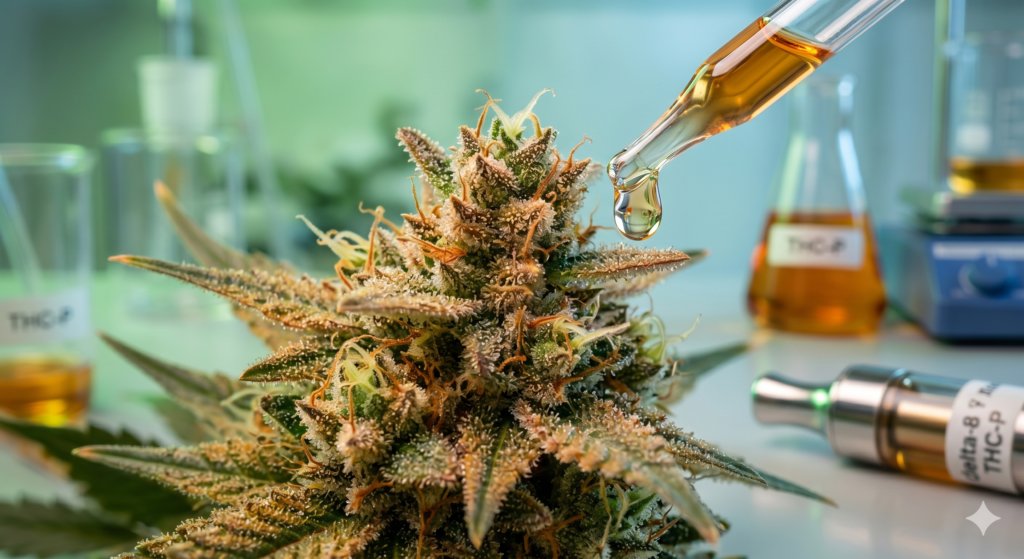
THC-P (tetrahydrocannabiphorol) is a naturally occurring, highly potent cannabinoid found in trace amounts in the cannabis plant. Because of its unique molecular structure, it binds up to 33 times more effectively to the body’s CB1 receptors than traditional delta-9 THC. This creates an extraordinarily intense, long-lasting euphoric and physical high.
So what is THC-P? THC-P is one of the newest and most talked-about cannabinoids in the hemp world, and most of that buzz comes down to a single word: potency. It was only identified in 2019, yet it has already become a headline ingredient in many high-strength products.
The challenge is that a lot of the marketing around THC-P leans on a “33x stronger” claim that gets the science wrong. The real story is more interesting and a lot more useful once you understand what that number actually measures.
THC-P, short for tetrahydrocannabiphorol, is a naturally occurring cannabinoid found in the cannabis plant in very small amounts. It belongs to the same family as the more familiar delta-9 THC, which is the compound most people picture when they think about feeling high.
What sets THC-P apart is its recent arrival on the scene. It was first isolated and described in 2019 by an Italian research team led by Cinzia Citti, with the findings published in the journal Scientific Reports. Before that paper, science simply did not know this cannabinoid existed in the plant.
The structural difference is the key to everything that follows. THC-P carries a seven-carbon alkyl side chain, while delta-9 THC has a five-carbon one, and that longer tail is what researchers believe lets THC-P interact with the body’s receptors so strongly. This seven-carbon side chain is the longest found in any naturally occurring cannabinoid identified to date, which is why THC-P stands out even within its own chemical family.
Why is THC-P considered so potent?
THC-P is considered so potent because it binds to CB1, one of the main receptors in the body’s endocannabinoid system, far more tightly than delta-9 THC does. The research behind this is real, but the way it gets repeated online is often misleading.
The 33x figure explained
You have probably seen THC-P advertised as roughly 33 times stronger than regular THC. That figure comes from the 2019 study, which measured how strongly THC-P attaches to the CB1 receptor in a lab setting.
In those binding tests, THC-P showed an affinity for CB1 that was about 33 times higher than delta-9 THC. The important part is that this is a measure of binding affinity in laboratory studies, not a measure of how intense the high feels. It does not mean one milligram of THC-P hits 33 times harder than one milligram of THC.
The longer side chain and CB1
The reason THC-P binds so tightly comes back to that seven-carbon side chain. Receptors recognize cannabinoids partly by the length of this tail, and a longer one can settle more deeply into the receptor’s binding pocket.
Delta-9 THC’s five-carbon chain already fits well, which is why it is active. THC-P’s extra length appears to improve that fit, which is the leading explanation researchers give for its stronger laboratory binding.
What the research actually measured
It helps to separate two ideas that often get blurred together. Binding affinity describes how readily a compound attaches to a receptor, while real-world potency describes how strong the experience feels at a given dose.
The 2019 study measured the first, not the second. Real-world potency depends on dosage, how the product is made, your tolerance, and how your body processes the compound, so the felt strength is lower than the binding number and varies from person to person.
Put simply, a high binding affinity tells you THC-P latches onto the receptor very efficiently, but it does not translate one-to-one into how intense the high feels at a given milligram dose. That gap between the lab number and the lived experience is exactly where most of the “33x stronger” marketing goes wrong.
What potency means for you in practice
For everyday use, the practical takeaway is simple: THC-P is genuinely strong and intoxicating, so the dose that feels right is much smaller than what you might use with milder cannabinoids. Anecdotal reports from users tend to describe an experience several times more intense than delta-9, not 33 times.
Because the effect can sneak up on you, the smartest approach is to start very low and wait before taking more. A useful rule of thumb is to treat a typical THC-P dose as a fraction of what you would take with delta-9, since a small amount of THC-P can match or exceed a much larger amount of regular THC. This is a compound to respect, and it is strictly for adults 21 and older.
How does THC-P compare to THC, Delta-8, and HHC?
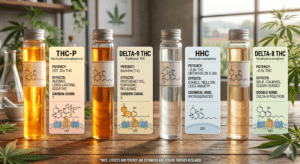
Compared to THC, Delta-8, and HHC, THC-P is the most potent of the four, binding to CB1 about 33 times more strongly than delta-9 THC in lab studies, while Delta-8 is the mildest and HHC sits close to delta-9. THC-P rarely shows up alone, so it helps to see how it lines up against the cannabinoids you are most likely to meet alongside it.
Cannabinoid
First described
Relative CB1 binding / potency
Intensity of effects
Typical onset
THC-P
2019 (Citti et al.)
About 33x delta-9 binding affinity in lab studies
Very high; anecdotal reports several times delta-9
Minutes inhaled; about 30 to 90 min as an edible
Delta-9 THC
1964
Baseline reference point
High; the familiar standard
Minutes inhaled; about 30 to 90 min as an edible
Delta-8 THC
1941
Lower than delta-9
Mild; roughly half of delta-9
Minutes inhaled; about 30 to 90 min as an edible
HHC
1944
Slightly below delta-9
Moderate; roughly 70 to 80 percent of delta-9
Minutes inhaled; about 30 to 90 min as an edible
THC-P vs Delta-9 THC
Delta-9 is the yardstick everyone else gets measured against, so this is the comparison that matters most. THC-P binds far more tightly to CB1 in lab studies, which is the source of that 33x headline.
In practice, the felt difference is much smaller than the binding ratio, but THC-P is still clearly the stronger of the two. If delta-9 is your reference for a “full” high, treat THC-P as a step well beyond it and dose accordingly.
THC-P vs Delta-8
Delta-8 sits at the gentle end of the scale, with effects many users describe as roughly half the strength of delta-9. It is often chosen for a lighter, clearer-headed experience.
THC-P lands at the opposite end. Putting the two side by side is the clearest way to see THC-P’s intensity, because the gap between a mild cannabinoid and a very potent one is hard to miss.
THC-P vs HHC
HHC is a hydrogenated cannabinoid that tends to feel close to delta-9, often landing somewhere around 70 to 80 percent of its strength. Many people reach for it as a middle-ground option.
THC-P is in a different weight class. Where HHC offers a balanced, familiar feel, THC-P brings noticeably more force, which is why the two are sometimes blended so each can do a different job.
What are the effects of THC-P, and how should you start?
The effects of THC-P are those of a strong, intoxicating cannabinoid, which means it produces a genuine high rather than a subtle, sober effect. Users commonly report strong euphoria, deep relaxation, and a heavier body sensation than they get from milder cannabinoids, with the experience often described as several times more intense than delta-9 at a comparable dose.
Onset depends on the format you choose. Inhaled products like vapes tend to take effect within minutes, while edibles can take roughly 30 to 90 minutes, so it is easy to take more too soon if you are not patient.
Because the experience can be powerful, starting very low is the most important rule. A good way to meet THC-P is in a measured blend, such as the products in our THC-P and cannabinoid lineup, where it is balanced with other cannabinoids. If you want to understand that formula first, here is what our KO Blend is in plain terms.
Where to start with THC-P
THC-P is a powerful, fast-rising cannabinoid, and the safest way to explore it is with lab-tested products and a low starting dose. At Pure Standard Extracts, we keep our blends clearly labeled so you always know the strength you are working with before you take that first puff or bite.
If you are not sure which THC-P product fits your tolerance, our team is glad to walk you through the options. Call us today to find a THC-P starting point that fits.
Disclaimer: These statements have not been evaluated by the Food and Drug Administration. This product is not intended to diagnose, treat, cure, or prevent any disease. For adults 21 and older. Individual results vary. Consult your healthcare provider before use, especially if you are pregnant, nursing, or taking medication.
Frequently Asked Questions
What is THC-P?
THC-P, or tetrahydrocannabiphorol, is a naturally occurring cannabinoid found in cannabis in tiny amounts. It was first identified in 2019 by an Italian research team and published in Scientific Reports. It is closely related to delta-9 THC but binds far more strongly to CB1 receptors in lab studies, which is why it is known for its potency.
Is THC-P stronger than THC?
Yes, THC-P is generally stronger than regular delta-9 THC. In laboratory binding studies it attached to the CB1 receptor about 33 times more readily than delta-9. That number reflects binding affinity, not the felt high, so real-world intensity is lower and varies by person, though most users still find it clearly more powerful.
What does THC-P feel like?
Most users describe THC-P as a strong, full-bodied high with noticeable euphoria and deep relaxation. Because it is more potent than delta-9 THC, the effects can feel heavier and last longer at smaller doses. It is intoxicating and meant only for adults 21 and older, so starting with a very low amount is wise.
Is THC-P natural or synthetic?
THC-P occurs naturally in the cannabis plant, but only in trace amounts. Because those amounts are so small, the THC-P in most hemp products is produced by converting other hemp compounds in a lab to reach a usable concentration. It is still the same molecule that the 2019 study found growing in the plant.
How is THC-P different from Delta-8?
THC-P and Delta-8 sit at opposite ends of the potency scale. Delta-8 is a milder cannabinoid, often described as about half the strength of delta-9 THC, with a clearer-headed feel. THC-P is far more potent and intoxicating, so the two are used for very different experiences and dosed very differently.
Will THC-P show up on a drug test?
Yes, THC-P can very likely cause a positive result on a standard drug test. Most tests screen for THC metabolites, and your body processes THC-P in a similar way to other forms of THC. If you face drug testing, it is safest to assume any THC product, including THC-P, could be detected.
How much THC-P should a beginner take?
Beginners should start with the smallest dose available and wait to feel the full effect before taking more. Because THC-P is much more potent than delta-9 THC, a tiny amount goes a long way, and edibles in particular can take 30 to 90 minutes to kick in. A measured blend makes it easier to control your dose.
Is THC-P legal?
THC-P derived from hemp exists in a legal gray area that depends on federal rules and your state’s laws. Some states restrict or ban intoxicating hemp cannabinoids, while others allow them. Because the rules change often, check your current state and local laws before buying or using any THC-P product.
Key Takeaways Reishi is a functional mushroom with a long history in traditional wellness, where it is most often associated with calm and rest. Research is still developing, so it is best understood as a traditional ingredient and not as a treatment for anything. Reishi is most commonly associated with
Key Takeaways There is no single amount of Amanita muscaria that is safe for everyone, because products, extracts and people all differ. The careful approach is to follow the label on a lab-tested product, begin with the smallest serving and give it plenty of time. We will not give you
Key Takeaways Amanita muscaria, also called fly agaric, is the red mushroom with white spots that most people recognize from fairy tales. It is a different species from psilocybin mushrooms and from everyday functional mushrooms, and it calls for more caution than either. Amanita muscaria is a wild mushroom known


 Delta-9 is the yardstick everyone else gets measured against, so this is the comparison that matters most. THC-P binds far more tightly to CB1 in lab studies, which is the source of that 33x headline.