Free Shipping over $75 | Ships Out Same-Day | SAVE 30% STOREWIDE, CODE "HALLOWEEN30"
HHC vs Delta-8: What’s the Difference, and Which One Is Right for You?
HHC and Delta-8 are both hemp-derived cannabinoids that produce mild psychoactive effects, but they differ in how they’re made, their effect profiles, and their shelf stability. HHC is a hydrogenated form of THC known for a more clear-headed experience and longer shelf life. Delta-8 is an isomer of THC associated with relaxation and a broader range of edible formats. Both operate under federal hemp law in the same way and carry similar drug testing considerations.
HHC and Delta-8 have both found a significant following in the hemp market, and they often appear together in multi-cannabinoid formulas precisely because they complement each other in ways that neither does alone. Understanding the difference helps you make a more informed purchase decision rather than choosing based on name recognition alone.
At Pure Standard Extracts, we use both HHC and Delta-8 in our KO Blend because we formulate products around the full cannabinoid picture, not a single-compound approach. Seeing how each cannabinoid works on its own makes the combination easier to understand and evaluate.
If you have questions about either cannabinoid or want help choosing the right product for your situation, contact us todayand our team will walk you through the options. We’re happy to discuss the specifics before you commit to a purchase.
HHC and Delta-8 Share the Same Legal Origin but Work Differently
Both HHC and Delta-8 are derived from hemp and operate under the same federal hemp framework established by the 2018 Farm Bill. The similarities end there. Each cannabinoid is produced differently, binds to receptors somewhat differently, and produces a distinct effect profile that users report as meaningfully different at comparable doses.
How HHC Is Made From Hemp
HHC (hexahydrocannabinol) is produced by a process called hydrogenation, which adds hydrogen atoms to THC molecules under controlled conditions. This is the same process used in food manufacturing to harden liquid oils into solid fats, applied to cannabis-derived molecules instead. The result is a cannabinoid that is chemically more saturated than THC and significantly more resistant to oxidation over time.
Because of its molecular stability, HHC degrades more slowly than Delta-8 or Delta-9 THC when exposed to heat, light, or oxygen. This makes HHC well-suited for certain product formats where shelf life matters, particularly disposable vapes and cartridges that may sit in storage for extended periods before use.
How Delta-8 Is Made From Hemp
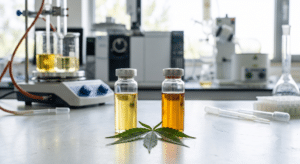
Delta-8 THC occurs naturally in hemp in trace concentrations, typically well below 1 percent of the plant’s total cannabinoid content. At commercial scale, Delta-8 is almost always produced by converting CBD into Delta-8 through an isomerization reaction using an acid catalyst. The process is chemically straightforward and well-understood, though the quality of the final product depends heavily on the refinement steps that follow the initial conversion.
Delta-8 products are widely available in gummy, tincture, vape, and capsule formats because the cannabinoid processes well across all of them. Consumer familiarity with Delta-8 is higher than with HHC in part because Delta-8 entered the commercial hemp market earlier and accumulated a larger base of user experience and published product reviews.
The Key Chemical Difference Between Them
HHC differs from Delta-8 at the molecular level by the double bond position and the degree of hydrogen saturation. Delta-8 has a double bond at the eighth carbon of the THC chain; HHC has no double bond in that chain at all, having been fully hydrogenated. This structural difference is what drives HHC’s greater stability and contributes to its slightly different receptor interaction profile compared to Delta-8.
Both cannabinoids bind to the same CB1 receptors in the endocannabinoid system that Delta-9 THC targets. Neither has the binding affinity of Delta-9, which is why both produce effects described as milder. The exact binding affinities for HHC and Delta-8 at CB1 are not fully characterized in peer-reviewed literature, and most effect comparisons available to consumers are based on user reports rather than clinical measurements.
The Effects of HHC vs Delta-8 Differ in Ways Users Notice
Consumer accounts and early observational reports consistently describe HHC and Delta-8 as producing distinct experiences despite both being milder than Delta-9 THC. The differences are not dramatic, but they are reliable enough that users with experience across both cannabinoids tend to have a clear preference for one or the other depending on what they’re trying to accomplish.
What HHC Typically Feels Like
HHC is most often described as producing a clear-headed, somewhat energetic effect at moderate doses. Users report that it tends to allow for more functional activity than Delta-8, with less of the couch-lock or heavy sedation that some people experience with Delta-9 THC or even higher doses of Delta-8. The effect onset and duration with HHC are similar to those of other cannabinoids in the same delivery format.
At higher doses, HHC becomes more noticeably psychoactive, and the clear-headed quality gives way to stronger intoxication. Most consumer guidance suggests treating HHC similarly to Delta-8 in terms of dosing caution for first-time users, starting low and waiting for the full effect before taking more.
What Delta-8 Typically Feels Like
Delta-8 is most commonly associated with relaxation and a mild body effect that some users describe as more physically grounding than HHC. It is frequently reported as producing a calmer, more sedating experience than HHC at comparable doses, which makes it a more common choice for evening use or for consumers looking for a wind-down effect.
The relaxation-forward profile of Delta-8 is part of what drives its popularity in gummy and edible formats, where slower onset and longer duration pair well with the sedating character of the cannabinoid. Users seeking a daytime cannabinoid with less sedation often prefer HHC for that reason.
How Onset and Duration Compare Between the Two
Onset time and effect duration for both HHC and Delta-8 are primarily determined by the delivery format rather than the cannabinoid itself. Inhaled formats (vapes, disposables) produce effects in minutes for both cannabinoids, typically 5 to 15 minutes post-use. Edibles take considerably longer, typically 45 to 90 minutes, because absorption through the digestive system is slower than through the lungs.
Effect duration follows the same pattern: inhaled formats produce shorter effects, typically 2 to 3 hours, while edibles extend to 4 to 6 hours or longer depending on individual metabolism. Neither HHC nor Delta-8 shows a meaningfully different onset or duration from the other when matched by format and dose.
HHC Has a Clear Stability Advantage Over Delta-8
The hydrogenation process that creates HHC also makes it significantly more resistant to chemical degradation than Delta-8. Delta-8 THC can oxidize over time when exposed to air, heat, or light, which causes it to convert to another cannabinoid called cannabinol (CBN) and reduces the potency of the product. HHC’s fully saturated molecular structure resists this oxidation process more effectively.
For consumers, this means that HHC-based products tend to retain their potency and quality for longer periods under typical storage conditions. A Delta-8 product stored improperly or near its expiration date may deliver a noticeably weaker experience than a fresh product; the same degradation concern is less acute with HHC products. This is one reason HHC is particularly common in disposable vape formats, where the product might sit unused for weeks or months.
For brands, HHC’s stability is an advantage in formulation because it creates less uncertainty about potency over a product’s shelf life. It is one of the reasons we include HHC alongside Delta-8 in our KO Blend rather than relying on Delta-8 alone.
HHC and Delta-8 Suit Different Situations
The choice between HHC and Delta-8 comes down to what you’re trying to accomplish and how you prefer to use a hemp cannabinoid product. Neither is universally better, but each has specific characteristics that make it a more natural fit for certain situations.
Comparison Point
HHC
Delta-8
Source process
Hydrogenation of hemp THC
Isomerization of hemp CBD
Commonly reported effect
Clear-headed, functional
Relaxing, mildly sedating
Shelf stability
Higher (resists oxidation)
Moderate (can degrade over time)
Common formats
Vapes, disposables, blends
Gummies, vapes, tinctures, blends
Drug test risk
May trigger positive result
May trigger positive result
Best for
Daytime use, active settings
Evening use, relaxation
For daytime or activity-adjacent use: HHC’s clearer effect profile makes it the more practical choice. For evening or relaxation-focused use: Delta-8’s more sedating character tends to be a better fit. Many users find that a multi-cannabinoid product like our KO Blend disposable is more satisfying than either cannabinoid alone, since the combination layers effects in a way a single-cannabinoid product cannot.
Both HHC and Delta-8 Appear Together in the KO Blend for a Reason
The KO Blend is built around a multi-cannabinoid approach that uses HHC and Delta-8 alongside THC-P, HHC-P, CBD, and CBN. Including both HHC and Delta-8 in the same formula is an intentional decision, not a default. HHC contributes the more functional, clear-headed layer of the experience; Delta-8 contributes the relaxation element; and the combination of both with higher-potency cannabinoids like THC-P and HHC-P creates a more rounded effect than any single compound could produce.
Third-party lab results confirm the cannabinoid profile of every batch, so buyers can verify exactly what each ingredient contributes to the formula before purchasing. Our lab reports are publicly available and updated with each production run. Reading the certificate of analysis for any product tells you the milligram contribution of HHC and Delta-8 individually, so you can evaluate the formula against your own preferences rather than relying on marketing claims.
Which Cannabinoid Makes Sense for Your Next Purchase
Both HHC and Delta-8 are solid entry points into hemp-derived cannabinoids for adults 21 and older who want an experience milder than Delta-9 THC but more pronounced than CBD. At Pure Standard Extracts, we make the lab documentation available precisely so you can evaluate each cannabinoid on its actual profile rather than on name recognition or marketing language.
If you’re not sure which cannabinoid fits your situation best, or if you want to talk through the differences before placing an order, don’t guess. Call us today and our team will walk you through the specific products in our lineup and help you find the right match.
Disclaimer: These statements have not been evaluated by the Food and Drug Administration. This product is not intended to diagnose, treat, cure, or prevent any disease. Hemp-derived cannabinoid products are intended for adults 21 and older. Consult a qualified healthcare provider before use, especially if you are pregnant, nursing, have a medical condition, or take prescription medications.
Frequently Asked Questions
What is the difference between HHC and Delta-8?
HHC and Delta-8 are both hemp-derived cannabinoids that produce mild psychoactive effects, but they are made differently and produce distinct experiences. HHC is created by hydrogenating THC, making it more shelf-stable and commonly described as producing a clearer, more functional effect. Delta-8 is made by isomerizing CBD and is more often associated with relaxation and mild sedation.
Is HHC stronger than Delta-8?
Consumer reports and observational accounts suggest HHC and Delta-8 are comparable in overall intensity, with HHC often described as slightly more potent than Delta-8 at the same milligram dose, though individual responses vary significantly. Neither is as potent as Delta-9 THC, and both are generally described as milder intoxicating alternatives to traditional cannabis.
Does HHC get you high?
Yes, HHC is a mildly psychoactive cannabinoid that produces intoxicating effects at typical consumer doses. Most users describe the experience as clear-headed and functional compared to Delta-9 THC, but HHC is not non-psychoactive. Adults using HHC for the first time should start at a low dose and wait for the full effect before taking more.
Does Delta-8 get you high?
Yes, Delta-8 THC is a mildly psychoactive cannabinoid. The experience is generally described as less intense than Delta-9 THC and more relaxing in character than HHC at comparable doses. Delta-8 is often associated with a body-heavy or sedating effect, particularly in edible form, and should be approached with appropriate dosing caution by first-time users.
Will HHC or Delta-8 show up on a drug test?
Both HHC and Delta-8 may cause a positive result on standard THC immunoassay drug tests because these tests screen for metabolites that both cannabinoids can produce. Neither cannabinoid is guaranteed to clear a standard panel. If you are subject to regular drug testing, using either HHC or Delta-8 carries meaningful risk of a positive result regardless of the product’s legal hemp-derived status.
Is HHC legal?
HHC derived from hemp exists in the same federal legal gray area as Delta-8. The 2018 Farm Bill legalized hemp-derived cannabinoids and their derivatives, and HHC derived from hemp is argued to fall within that definition. Several states have moved to restrict HHC explicitly, so the legal status varies by state. Consult current state-specific guidance before purchasing.
Can you use HHC and Delta-8 together?
Yes. Multi-cannabinoid products combining HHC and Delta-8 are commercially available and commonly used. Consumer reports suggest the combination produces a more layered effect than either cannabinoid alone, consistent with the entourage effect concept that cannabinoids may interact synergistically. These statements have not been evaluated by the FDA, and we do not claim that any product combination treats or prevents any condition.
What product format is best for HHC vs Delta-8?
HHC is most commonly found in vape and disposable formats because its molecular stability is particularly advantageous in products where shelf life and heat stability matter. Delta-8 is widely available in gummies, tinctures, capsules, and vapes. If your priority is onset speed and shorter duration, an inhaled format works for both; if you prefer longer duration, an edible format using Delta-8 or a blend product is more common.
Key Takeaways A Delta-8 gummy starts as hemp extract, gets blended into a warm gelling base, then set in moulds and finished. The tricky part is keeping the mix even so every piece comes out the same. Hemp is extracted, the extract is blended into a warm gelling base along
Key Takeaways Fruit flavours dominate the Delta-8 gummy category because they sit well alongside the taste of hemp extract. Flavour is mostly a preference question, though it can hint at how a product was built. Fruit is the overwhelming answer. Berry, citrus, tropical and stone fruit turn up most across
Key Takeaways Live rosin gummies are edibles made with a solventless hemp extract rather than a refined, neutral base. The difference shows up mostly in how they taste, since the extract carries the plant’s own character. Live rosin gummies are edibles built around live rosin, a solventless extract pressed from

 Delta-8 THC occurs naturally in hemp in trace concentrations, typically well below 1 percent of the plant’s total cannabinoid content. At commercial scale, Delta-8 is almost always produced by converting CBD into Delta-8 through an isomerization reaction using an acid catalyst. The process is chemically straightforward and well-understood, though the quality of the final product depends heavily on the refinement steps that follow the initial conversion.