Free Shipping over $75 | Ships Out Same-Day | SAVE 30% STOREWIDE, CODE "HALLOWEEN30"
THC-P vs Delta-8: Which Cannabinoid Is Stronger, and What Should You Expect?
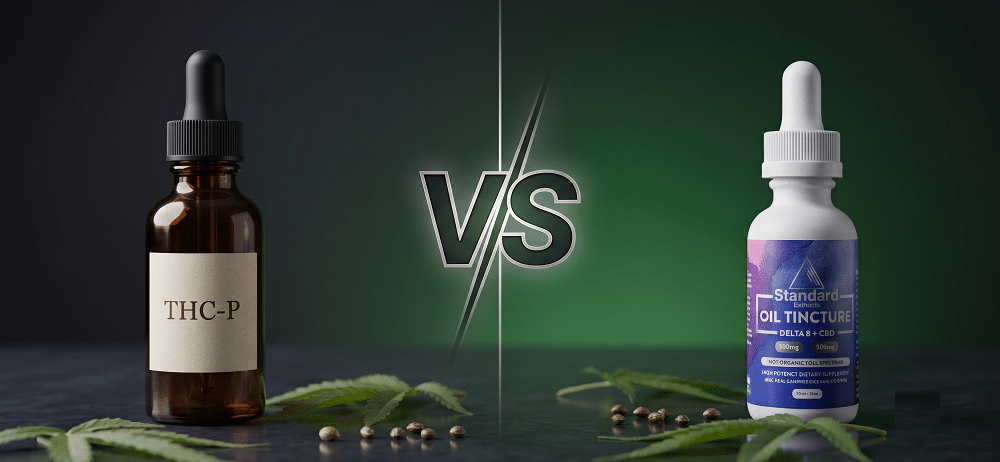
THC-P and Delta-8 are both hemp-derived cannabinoids, but they are not close in potency. Research suggests THC-P may bind to CB1 receptors with roughly 33 times the affinity of Delta-9 THC, while Delta-8 sits at an estimated 50 to 70 percent of Delta-9 strength. For adults 21 and older weighing the two, the difference in ceiling, onset, and starting dose is significant, not a marketing distinction.
You have tried Delta-8 and found a manageable, measured experience. Now THC-P is appearing on labels, and this THC-P vs Delta-8 guide is designed to close that gap before you make a purchase you are not ready for. That difference in potency is the whole story.
At Pure Standard Extracts, we carry both cannabinoids and believe buyers deserve plain-English education before they commit to a product. Understanding where each compound sits on the potency spectrum, how it acts in the body, and what a responsible starting dose looks like is the foundation of a safe experience.
Contact us todayif you have questions about our products or need help choosing the right cannabinoid for your experience level.
What THC-P and Delta-8 Are
Both compounds come from hemp and fall under the legal framework of the 2018 Farm Bill, which permits hemp-derived cannabinoids at or below 0.3 percent Delta-9 THC by dry weight. Beyond that shared legal origin, they are structurally and pharmacologically distinct.
The Discovery and Structure of THC-P
THC-P, or tetrahydrocannabiphorol, was identified in 2019 by a team of Italian researchers publishing in Scientific Reports (Citti et al., 2019). The molecule differs from conventional Delta-9 THC at its alkyl side chain: THC-P carries a seven-carbon chain compared to the five-carbon chain on Delta-9. That structural difference appears to be the source of its elevated binding behavior at the body’s cannabinoid receptors.
The Origin and Structure of Delta-8
Delta-8-THC is an isomer of Delta-9 THC, meaning the atoms are the same but arranged slightly differently, with the double bond sitting at the 8th carbon position rather than the 9th. It occurs naturally in hemp in trace amounts, so commercial Delta-8 is typically converted from CBD through an isomerization process. The compound has been available in the hemp market for several years and has a well-documented consumer profile.
Is THC-P vs Delta-8 Legal to Buy?
Both cannabinoids are sold as hemp-derived products under federal law, provided final products contain no more than 0.3 percent Delta-9 THC by dry weight. State laws vary, and a handful of states have restricted or banned one or both compounds. Federal hemp regulations are actively changing, so buyers should verify the laws in their state and monitor federal updates before purchasing any hemp-derived cannabinoid product.
Why the Comparison Matters for Buyers
Choosing between THC-P and Delta-8 is not a cosmetic decision. The two compounds produce experiences that differ in intensity, duration, and appropriate starting dose. For adults new to hemp cannabinoids or returning after a break, starting with the wrong compound at the wrong dose is the most common source of an uncomfortable experience.
How Potency Differs Between THC-P and Delta-8
The core difference between THC-P and Delta-8 is the degree to which each compound engages the body’s endocannabinoid system, specifically the CB1 receptor in the brain and central nervous system. Research suggests that CB1 binding affinity is closely tied to the intensity of psychoactive effects.
CB1 Receptor Binding Affinity
The 2019 Citti et al. research team found that THC-P demonstrated approximately 33 times the CB1 binding affinity of conventional Delta-9 THC in laboratory assays, as reported in Scientific Reports (Citti et al., 2019). Delta-8, by comparison, is generally estimated at roughly 50 to 70 percent of Delta-9’s CB1 binding affinity. Expressed simply, THC-P’s receptor engagement is dramatically higher than Delta-8’s on paper. Binding affinity in a lab assay does not translate directly or proportionally to the real-world subjective experience.
What Binding Affinity Actually Means
A higher binding affinity means the molecule fits more tightly and persistently into the receptor, which research associates with a stronger and more sustained activation signal. It does not mean the resulting experience is arithmetically 33 times more intense than Delta-9 or 60 times more intense than Delta-8. Individual physiology, tolerance, delivery method, and dose all shape the final experience. The affinity figure is best understood as a ceiling indicator, not a multiplier.
How Strong Is THC-P in Practice?
In practical terms, the consensus among experienced cannabinoid users is that THC-P produces a notably heavier, longer-lasting effect than Delta-8 at equivalent milligram doses. Products formulated with THC-P are typically dosed at 1 to 3 mg per serving, while Delta-8 products commonly suggest 10 to 25 mg as a starting range. That dosing gap reflects how the compounds behave differently in real-world use.
Does Your Delta-8 Tolerance Carry Over to THC-P?
A person who uses Delta-8 regularly has built some tolerance to CB1 stimulation, but that tolerance does not transfer fully to THC-P. Experienced Delta-8 users who step into THC-P without adjusting their dose are one of the more common use-case mismatches in the hemp cannabinoid market. Experienced users should start lower than they think necessary, regardless of their Delta-8 history.
Delta-8 vs THC-P Effects: What to Expect
Potency numbers are useful context, but what most buyers want to know is how each compound feels in practice. Both THC-P and Delta-8 produce psychoactive effects, but the character and arc of those effects differ in several meaningful ways.
Onset Window and Duration
Delta-8 edibles typically take 45 to 90 minutes to take effect, based on user-reported experience and general cannabinoid pharmacokinetics, with effects peaking around the 2-hour mark and tapering over 4 to 6 hours. THC-P in an inhaled form may be felt within 15 to 45 minutes; in an edible format, onset may range from 60 to 120 minutes depending on metabolic rate and whether the product was taken on an empty stomach. THC-P effects are generally reported as longer-lasting than Delta-8 at equivalent subjective intensity.
Intensity and Character of Effects
Delta-8 is widely described as producing a clear-headed, functional experience at moderate doses: relaxed, mildly euphoric, with less cognitive disruption than full-strength Delta-9. THC-P at typical product doses may produce a more pronounced sedative quality, stronger body effects, and a higher ceiling of intoxication. Neither compound is appropriate for driving, operating machinery, or any activity requiring full alertness.
Starting Dose Recommendations
Responsible dosing starts with knowing the gap between the two compounds. Most industry guidance points to these starting ranges for adults with no recent cannabinoid experience:
Delta-8: 10 to 25 mg is the commonly cited starting range for edibles; lower for inhaled products
THC-P: 1 to 3 mg is the widely cited starting dose, well below a typical Delta-8 serving
Wait time: a full 90 minutes after an edible before considering any additional serving, for either compound
Tolerance reset: if you have not used cannabinoids in 6 months or more, start at the low end of Delta-8 regardless of prior history
Taking an additional serving before the onset window closes is the most common cause of overconsumption with both compounds.
Suitability by Experience Level
Delta-8 is generally considered the more accessible entry point for adults new to hemp cannabinoids or those who prefer a milder experience. THC-P is better suited to adults with a solid Delta-8 or Delta-9 baseline who are specifically seeking a higher-ceiling product. If you are not sure which describes you, Delta-8 is the safer first choice.
How to Choose Between THC-P and Delta-8
The right choice depends on your experience level, your tolerance baseline, your preferred delivery method, and what outcome you are trying to achieve. The table below summarizes the key decision factors side by side.
Factor
THC-P
Delta-8
Potency level
Very high (research suggests ~33x CB1 affinity of Delta-9)
Moderate (estimated ~50 to 70% of Delta-9)
Suggested starting dose
1 to 3 mg
10 to 25 mg
Onset (edible)
60 to 120 minutes
45 to 90 minutes
Best suited for
Adults with established cannabinoid tolerance seeking a higher ceiling
Adults new to hemp cannabinoids or preferring a milder experience
Yes. See our lab reports for cannabinoid concentrations per product
If you are choosing between the two for the first time, consider your recent cannabinoid history honestly. Adults returning after a break of six months or more should start with Delta-8 regardless of prior tolerance. Those with a consistent Delta-8 baseline who find standard doses no longer producing noticeable effects may find THC-P to be the appropriate next step.
For buyers who want both compounds in one product, our lab-tested hemp and cannabinoid lineup includes the KO Blend, which combines THC-P with Delta-8, HHC, HHC-P, CBD, and CBN in a single formula built for experienced users. [CONFIRM: verify full KO Blend cannabinoid stack, specifically HHC-P and CBN, against current product label or lab report before publishing.]
Which Cannabinoid Is Right for You?
The potency gap between THC-P and Delta-8 is not a marketing distinction. At Pure Standard Extracts, we source and test every cannabinoid product to ensure the concentration on the label reflects what is actually in the product, because that accuracy is what makes responsible dosing possible. Every product in our lineup is tested by an independent third-party laboratory, with Certificates of Analysis published openly.
Starting conservatively and waiting for the full onset window is the single most effective way to have a positive experience with either compound. Call us today to speak with our team about which product fits your experience level and what to expect before your first use.
Disclaimer: These statements have not been evaluated by the Food and Drug Administration. This product is not intended to diagnose, treat, cure, or prevent any disease. For adults 21 and older. Individual results vary. Consult your healthcare provider before use, especially if you are pregnant, nursing, or taking medication.
Frequently Asked Questions
Is THC-P stronger than Delta-8?
Research suggests THC-P is dramatically stronger than Delta-8. Laboratory data indicates THC-P may bind to CB1 receptors with approximately 33 times the affinity of Delta-9 THC, while Delta-8 is estimated at roughly 50 to 70 percent of Delta-9 strength. In practical terms, effective doses of THC-P are measured in single milligrams versus tens of milligrams for Delta-8.
What does THC-P feel like compared to Delta-8?
THC-P is generally reported to produce a stronger, longer-lasting, and more sedative experience than Delta-8 at equivalent subjective intensity. Delta-8 is widely described as clear-headed and functional at moderate doses. THC-P may produce a heavier body effect and a higher intoxication ceiling, with individual results varying by dose, delivery method, tolerance, and metabolism.
Is THC-P safe to use?
THC-P is a psychoactive compound, and its long-term safety profile has not been established by large-scale clinical research. It is intended for adults 21 and older only. Users should start at 1 to 3 mg, wait the full onset window before redosing, and avoid mixing with alcohol or other substances. Consult a healthcare provider before use if you have any medical conditions or take prescription medications.
How much THC-P should a beginner take?
Most formulators recommend 1 to 3 mg of THC-P as a starting dose for adults new to the compound, even those with an established Delta-8 tolerance. Wait at least 90 minutes after an edible before considering any additional serving. Taking too much before the full onset window is the most common cause of an uncomfortable THC-P experience.
Is THC-P legal?
THC-P derived from hemp has been federally legal under the 2018 Farm Bill when the final product contains no more than 0.3 percent Delta-9 THC by dry weight. Federal hemp regulations are actively changing, and state laws vary significantly. Always verify your state’s current regulations and monitor federal updates before purchasing any hemp-derived psychoactive cannabinoid.
How long does THC-P last?
THC-P effects are generally reported as longer-lasting than Delta-8 at comparable subjective intensity. In edible form, effects may last 6 to 8 hours or longer depending on dose and individual metabolism. In inhaled form, onset is faster at roughly 15 to 45 minutes, but duration still varies by dose and tolerance.
Can you mix THC-P and Delta-8 in the same product?
Yes. Some products, including multi-cannabinoid blends, combine THC-P and Delta-8 alongside other compounds like HHC and CBN. When using a blend, the combined potency of all active cannabinoids determines the appropriate dose. Start lower than you would with either compound alone, and review the lab report to understand the concentration of each cannabinoid in the product.
What is the difference between THC-P and Delta-9 THC?
THC-P and Delta-9 THC share a similar molecular backbone, but THC-P carries a seven-carbon alkyl side chain versus the five-carbon chain on Delta-9. Research suggests this difference produces significantly higher CB1 receptor binding affinity for THC-P, as confirmed in Scientific Reports (Citti et al., 2019). Delta-9 is the primary psychoactive compound in conventional cannabis, while THC-P is a naturally occurring trace cannabinoid first identified in 2019.
Key Takeaways A Delta-8 gummy starts as hemp extract, gets blended into a warm gelling base, then set in moulds and finished. The tricky part is keeping the mix even so every piece comes out the same. Hemp is extracted, the extract is blended into a warm gelling base along
Key Takeaways Fruit flavours dominate the Delta-8 gummy category because they sit well alongside the taste of hemp extract. Flavour is mostly a preference question, though it can hint at how a product was built. Fruit is the overwhelming answer. Berry, citrus, tropical and stone fruit turn up most across
Key Takeaways Live rosin gummies are edibles made with a solventless hemp extract rather than a refined, neutral base. The difference shows up mostly in how they taste, since the extract carries the plant’s own character. Live rosin gummies are edibles built around live rosin, a solventless extract pressed from

 Delta-8-THC is an isomer of Delta-9 THC, meaning the atoms are the same but arranged slightly differently, with the double bond sitting at the 8th carbon position rather than the 9th. It occurs naturally in hemp in trace amounts, so commercial Delta-8 is typically converted from CBD through an isomerization process. The compound has been available in the hemp market for several years and has a well-documented consumer profile.